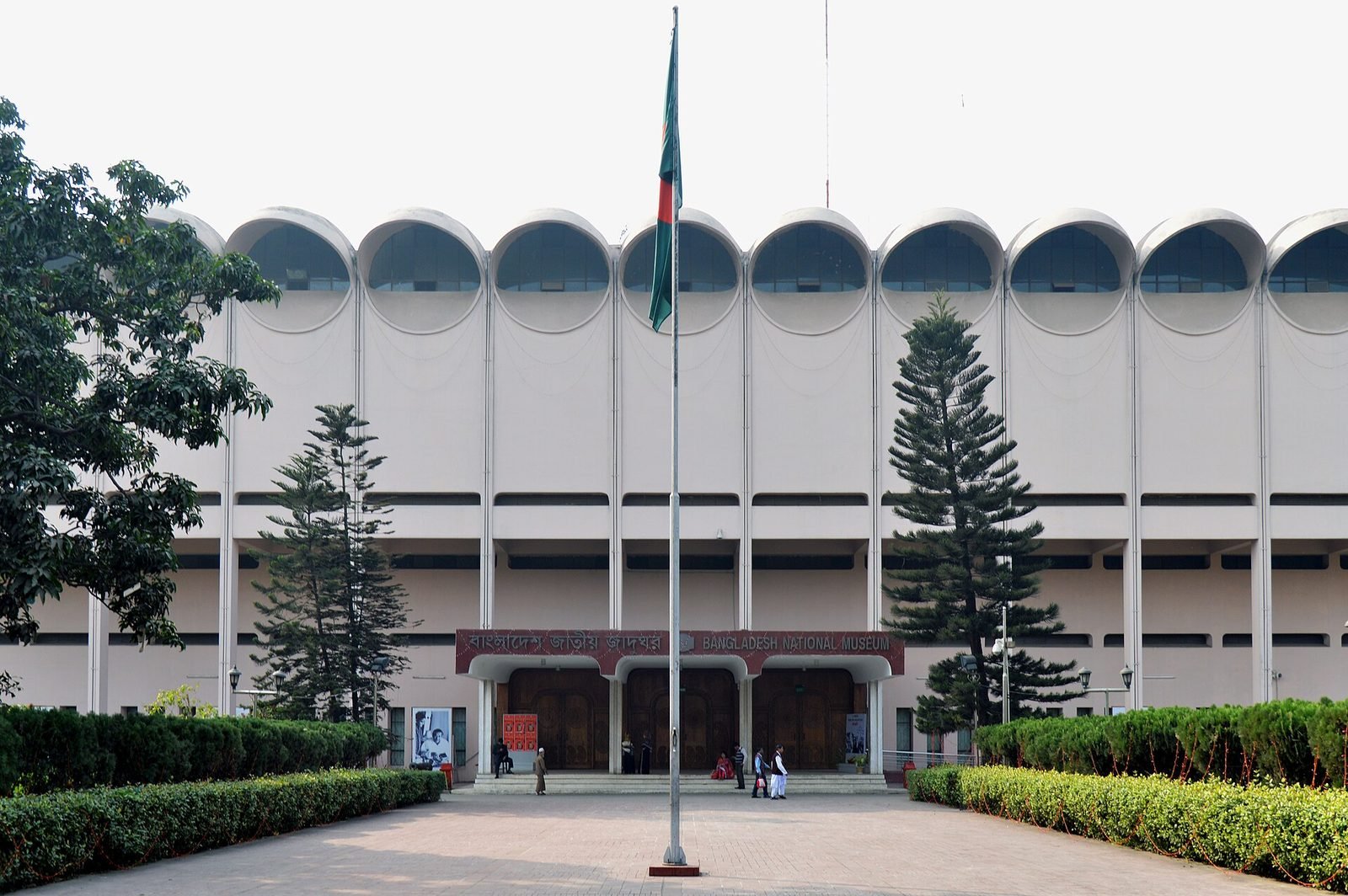
The Ethnological Museum was set up by the Department of Archaeology in 1965 on 1.25 acres at Agrabad, near Badamtali, and opened to the public on 9 January 1974. It is the only museum in the country devoted to its ethnic communities.
Three of its four galleries show the tools, weapons, clothing, jewellery, boats and household things of about 25 communities: the Chakma, Marma, Tripura, Mro, Bawm, Khiang, Khumi, Chak, Rakhine and Pangkhua of the Chittagong Hill Tracts; the Khasi and Manipuri of Sylhet; the Garo, Hajong and Koch of Mymensingh; the Santal, Oraon and Rajbanshi of Rajshahi and Dinajpur; and others. Many of the objects come from ways of life that are disappearing.
The fourth gallery compares communities from India, Pakistan, Kyrgyzstan, Australia and Germany, and among its exhibits is a fragment of the Berlin Wall. A hall of maps and murals introduces the festivals of the hill peoples, and there is a garden in front.
The building has suffered from leaks and neglect in recent years, so some galleries may be dim or under repair.

 Museums
Recommended